Common Name: Hackberry
Scientific Name: Celtis occidentalis
Location: Quadrangle
Identifying Features
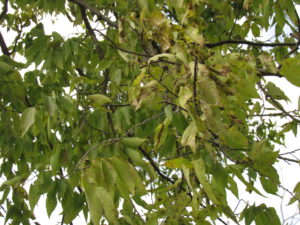
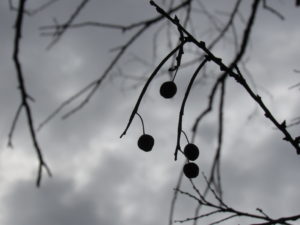
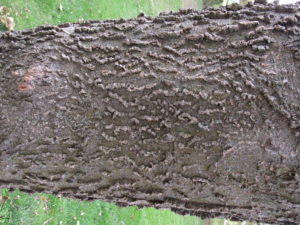
The bark of hackberry is one of its most distinctive features – it is often described as ‘warty’ due to conspicuous corky projections. The leaves are asymmetrical (wider on one side) and the lobes at the base of the leaf are unequal in size. Hackberry flowers open in the spring but are small and inconspicuous. By fall, flowers give way to purple berry-like fruits that may persist on the tree in winter.
Distribution/Geography
Hackberry is commonly found on rich, moist sites along stream banks or on flood plains, but will perform well under more adverse conditions. Hackberry is distributed throughout the eastern and midwestern United States.
Uses
The hackberry was traditionally used for many medicinal and food purposes. The bark was used to regulate menstrual cycles, colds, and sore throats. The fruit was often mixed with fat and corn to produce a porridge-like substance and it was also pounded into a paste and baked in the oven. It is also one of the best trees for providing food and shelter to birds and small animals.
History
Commonly known as the sugarberry or false elm, the hackberry is a member of the elm (Ulmaceae) family. The genus Celtis comes from the Latin name of the African lotus tree in reference to its sweet fruit while the specific epithet occidentalis means western or of the western hemisphere, appropriately named by Carl Linnaeus (a Swedish botanist). It is also said that the word “hack” comes from the Scottish word “hag” (meaning witch) in reference to the hagberry tree (Prunus padus), which early colonists confused with the hackberry because of the similarities between their small, cherry-like fruits and growth habits.
Fun Fact
The hackberry produces small, pea-sized berries that change from light orange to dark purple in color when ripe in early fall. Parts of the sugarberry and hackberry trees have been used in the production of drugs, to make various craft items, and used for firewood.