
Common Name: Tulip Tree
Scientific Name: Liriodendron tulipifera
Location: Red Barn Park
Identifying Features
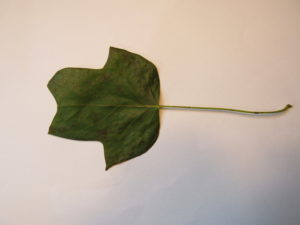
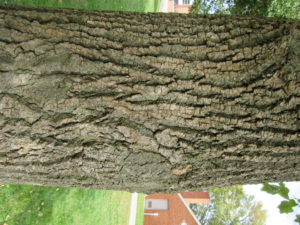
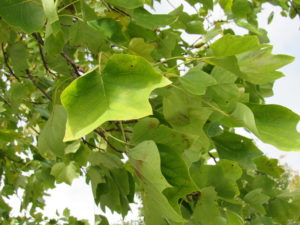
Tulip trees are widely planted as an ornamental, but they are native to just a few counties in southeast Missouri. The oddly-shaped leaves have a flat base, several pointed lobes, and a shallowly U-or V-shaped tip. The leaves fully expand in the spring before the large, tulip-shaped flowers open. The flower’s petals are yellow-green with conspicuous orange bands on their upper surface. Woody, cone-shaped fruits consist of numerous flat, winged units.
Needs Distribution/Geography
Tulip trees occurs in eastern North America. The species ranges from Vermont, west through southern Ontario and Michigan, south to Louisiana, and east to northern Florida.
Uses
The tulip tree is most commonly used in making furniture, cabinetry, musical instruments, and wood veneer.
History
In Tennessee tulip tree is sometimes called canoe wood because Native Americans and early settlers carved canoes from its light, buoyant trunks. Daniel Boone chose such a canoe to carry his own family from Kentucky to the western frontier.
Fun Fact
This tree is the tallest of North American hardwoods, growing to 100 feet or more.