Common Name: American Holly
Scientific Name: Ilex opaca
Location: Ophelia Parrish
Identifying Features
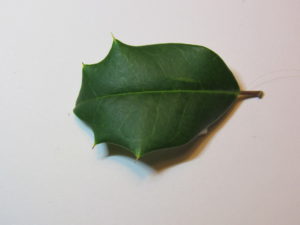
Holly’s shiny evergreen leaves and bright red berries make it a popular ornamental tree. The berries are produced by female trees; male trees produce pollen only. The two trees on either side of the entrance to Ophelia Parish are female; the one further south is male
Distribution/Geography
American holly spreads from eastern Massachusetts through mid-Florida, west to Texas, and is suited to a wide variety of site conditions. It is commonly grow well on drained, sandy soils, but can tolerate those which are very poorly drained.
Uses
– English holly and American holly are used as ornamental Christmas greens.
– The wood is very pale, tough, close-grained, takes a good polish, and is used for whip-handles, engraving blocks and also cabinet work. It can also be dyed and used as a substitute for ebony.
– After being dried, the leaves make a perfect tea that tastes very close to regular black tea, but with no caffeine.
– The berries are very poisonous to human and should not be swallowed.
– American holly is an important fall and winter food source for many birds and even mammals.
History
Historically, American holly fruit tea was used as a heart stimulant by American Indians. Yaupon, another type of holly, was used to cause vomiting, and Yaupon tea was used as a ceremonial “cleanser” in South America.
Fun Fact
We all know Southerners cannot live without their sweat tea. So during the Civil War, in the South, when the Union blockade halted all exports of British tea to the Confederacy, the holy-leaf tea became a popular replacement.