Common Name: Catalpa
Scientific Name: Catalpa bignonioides
Location: Sunken Garden
Identifying Features
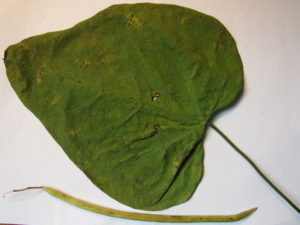
Catalpa has large heart-shaped leaves that attach in pairs (or threes) along the stem. Trees produce conspicuous white, bell-shaped flowers by early summer and long slender fruit pods dangle from its branches in fall and winter.
Needs Distribution/Geography
In the USA, Catalpa bignonioides is undoubtedly a Southern tree. Europeans first observed the tree growing in the fields of the Cherokee Native American tribes. However, it can flourish in the North as well, and accordingly its original range is somewhat in doubt. Despite its southern origins, it has been able to grow almost anywhere in the United States and southernmost Canada, and has become widely naturalized outside its restricted native range
Uses
Modern industrial uses of Catalpa bignonioides include general construction work, interior finish, cabinetwork, fence posts, rails, and fuel. The tree is also used as an ornamental shade tree and planted in urban areas as a street and lawn tree.
History
The genus was common in Europe during the Tertiary period. In North America its fossil remains have been discovered in the Miocene rocks of the Yellowstone River
Fun Fact
The name derives from the Muscogee name for the tree, “kutuhlpa” meaning “winged head,” but is unrelated to the name of the Indigenous Catawba people.