Common Name: American Sycamore
Scientific Name: Platanus occidentalis
Location: Quadrangle
Identifying Features
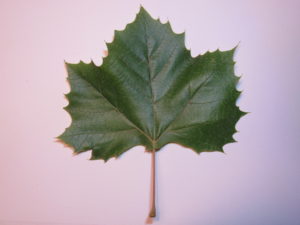
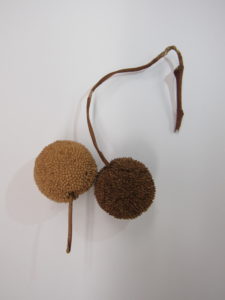
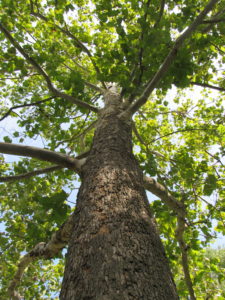
Reaching heights of 60-120 ft, Sycamores are among the largest of deciduous trees in the United States. They can reach up to 10 ft of growth in the first year. A mature sycamore has reaching horizontal branches with alternate simple leaves. These hairy leaves have 3-5 pointed lobes and can be as large as a dinner plate. They are green throughout the summer and turn yellow to brown in Autumn. The male flowers are yellow while the female flowers are red. The fruit can be described as a hanging golf ball sized multiple of achenes. The bark has a unique camouflage pattern with reddish-brown bark towards the base peeling off towards the top to reveal a white inner bark.
Distribution/Geography
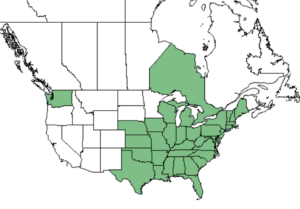
Sycamore is found in Central to Eastern United States in lowlands along river banks. This native tree prefers wet soils that are well-drained. Under good conditions they can live up to 250 years.
Uses
They are often used as street trees for aesthetics and filter city pollution but they can drop undesirable debris. They are also commonly used to make buttons and furniture.
History
Native Americans and pioneers would use the large trunk to make dugout canoes.
Fun Fact
During the war on the Brandywine Battlefield Park in Pennsylvania in the 18th century, one old sycamore tree provided shelter for General Washington’s large troops. Since then, the sycamore tree has been symbolized as hope and protection for the United States.